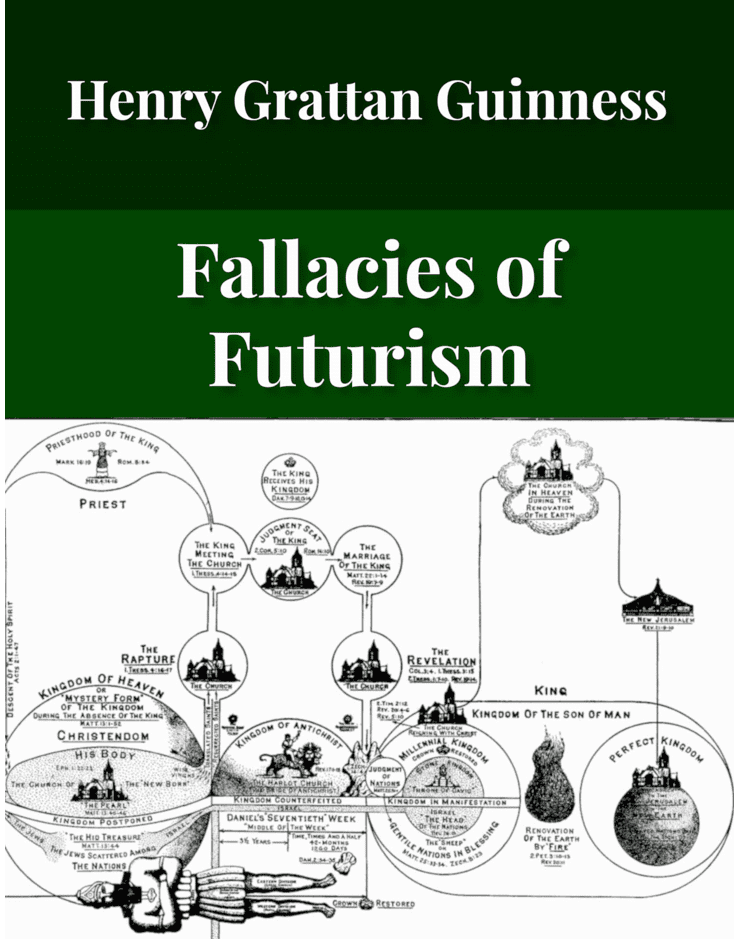
Henry Grattan Guinness
The next objection, or group of objections, is embodied in the following list of questions:
“But besides this, Mr. Guinness denies that ‘the Antichrist cometh’ (ὀ ἀντίχριστος ἔρχεται — 1 John 2:18). There is no Antichrist to come, for he has come already in the Papacy. But when did the Papacy make a Covenant with the Jews, and take away the daily sacrifice, and set up in its stead the abomination of desolation at Jerusalem, as the Lord said to the Jews? And again our Lord says, ‘If another shall come in his own name, him ye will receive,’ All the passages that speak of these things must be blotted out. For when did the Pope make a covenant with the Jews, or when did the Jews ever ‘receive’ a Pope as their Messiah? or by what scriptural authority is the idolatrous building of St. Peter’s, at Rome, called ‘The Temple of God’? or why are the Jews and Jerusalem altogether excluded from Mr. Guinness’ theory? Have they nothing to do with Antichrist in the last days? or with Daniel’s days and the ‘little horn’ or last king?”
To reply first to the first of these assertions, does the writer mean to imply that because Antichrist was a future power in the days of John, therefore he must needs be a future power still? That were a foolish assumption indeed! If he has come already, of course he is not still to come! The real question to be considered is just this: Has he come already? Has every prediction about Antichrist been fulfilled in the history of the Papacy? We have shown that such is the case.
The questions which follow assume that certain leading predictions have not been so fulfilled. But before this assumption can have any weight, it must first be proved that the predictions in question refer to Antichrist at all; and this cannot be proved, but can on the contrary be very clearly disproved.
[1] It is assumed, as if it were demonstrable, that Antichrist is to make a covenant with the Jews, who will receive him as their Messiah; that he is then to break his covenant with them, take away the daily sacrifice, or put down their religion by persecution.
Not only by this writer, but by all writers of the Futurist school, are these supposed future acts of the supposed future Antichrist largely discussed and gravely insisted on. To hear their disquisitions on the subject, one would suppose that “Antichrist’s seven years covenant with the Jews” was as unquestionable an event as God’s covenant with Israel on Sinai! Few would surmise how frail the foundation on which this cardinal doctrine of Futurism rests! Few would suppose that the notion has really no solid ground at all in Scripture, but is derived from an erroneous interpretation of one single clause of one single text! The only basis for the idea is the expression in the 27 th verse of the 9th chapter of Daniel: “He shall confirm the covenant with many for one week, and in the raids t of the week he shall cause the sacrifice and oblation to cease.” The sentence occurs in the midst of Daniel’s celebrated prophecy of the seventy weeks, a prophecy which does not even allude to Antichrist, but is exclusively occupied with the first advent of Christ, His rejection and death, and the Roman destruction of Jerusalem, which was the result!
Interpreted in the light of history, as a fulfilled prophecy, this remarkable chronological prediction affords conclusive evidence of the Messiahship of Jesus of Nazareth, of the inspiration of Scripture, and of the Divine origin of the Christian faith. One of the gravest evils of Futurism is the terrible way in which it tampers with this great fundamental prophecy, applying to the future doings of some ideal Antichrist its Divine description of the past deeds of the historic Christ.
What are the words of this sacred and marvelous prediction given between five and six hundred years before Christ? “Seventy weeks are determined upon thy people and upon thy holy city, to finish the transgression, and to make an end of sins, and to make reconciliation for iniquity, and to bring in everlasting righteousness, and to seal up the vision and prophecy, and to anoint the most Holy. Know therefore and understand, that from the going forth of the commandment to restore and to build Jerusalem unto the Messiah the Prince shall be seven weeks, and threescore and two weeks: the street shall be built again, and the wall, even in troublous times. And after threescore and two weeks shall Messiah be cut off, but not for Himself: and the people of a prince that shall come shall destroy the city and the sanctuary; and the end thereof shall be with a flood, and unto the end of the war desolations are determined.
“And He (Messiah) shall confirm the covenant with many for one week (or during the one or last week): and in the midst of the week He shall cause the sacrifice and the oblation to cease, and for the overspreading of abominations He shall make it (i.e., the city) desolate, even until the consummation, and that determined shall be poured upon the desolate” or desolator (Dan. 9:24-27).
This prophecy was given just as the seventy years’ captivity in Babylon was drawing to a close. It announced the duration of the restored national existence of Israel up to the great epoch of all history, the advent of Messiah the Prince. It was foretold that within 490 years from the date of the decree to restore and to build Jerusalem, the long foreshadowed, long predicted supreme atonement for sin was to be accomplished by the advent of Messiah the Prince, reconciliation for iniquity effected, and everlasting righteousness brought in; that vision and prophecy should be sealed up, and the most Holy anointed.
The period was then subdivided into three parts: 7 weeks, 62 weeks, and 1 week; i.e., 49 years, 434 years, and 7 years. The rebuilding of the city, and the re-establishment of the Jewish polity would occur in the first forty-nine years or “seven weeks.” Four hundred and thirty-four years more would elapse, and then Messiah the Prince would appear. After that, at some time not exactly specified, but within the limits of the seventieth week or last seven years of the period, Messiah would be cut off; but not for Himself. It is further foretold that Jerusalem and its temple would subsequently, and as a consequence, be destroyed, and that a flood of foreign invasion would overflow the land. But though thus cut off, Messiah would confirm the covenant with many (not the whole nation) during the course of the “one week” (i.e., the last week of the seventy); in the midst of it He would “cause sacrifice and oblation to cease.” Jerusalem should then be made desolate, until a certain predetermined doom should fall upon the power that should desolate it; a fact which our Lord afterwards foretold in the words, “Jerusalem shall be trodden down of the Gentiles, until the times of the Gentiles be fulfilled.”
All this was accomplished with wonderful exactness. The edict to restore and build the city was issued by Artaxerxes, and Ezra and Nehemiah were the two great restorers of the Jewish people, polity, and religion. Their joint administration occupied about “seven weeks,” or forty-nine years; the wall and the street were rebuilt in troublous times. After the lapse of 434 years more, Messiah the Prince did appear, saying, “The time is fulfilled, and the kingdom of God is at hand; i.e., the time indicated by this very prophecy. He came unto His own, and alas! His own received Him not! He was cut off, but not for Himself! Shortly after the Roman soldiery —”the people of a prince that shall come (Titus) did destroy the city and the sanctuary; the end of Jewish independence came with a flood of foreign invasion, and predetermined desolation fell on land and people. But though the nation was thus judged, Messiah did “confirm the covenant” with many; not with Israel as a people, but with an election according to grace.
What covenant? and how did He confirm it? “This is the new covenant in My blood, which is shed for you,” said He to His disciples the night before His passion (Luke 22:20); or as Matthew and Mark give the words: “This is My blood of Hie new covenant, which is shed for many for the remission of sins.” “He shall confirm the covenant with many,” said the angel to Daniel. “My blood of the new covenant shed for many,” said Christ. Is not His blood declared to be “the blood of the everlasting covenant”? And is not He Himself repeatedly styled “the Mediator of the new covenant”? (See Heb. 8:6; 9:15; 12:24.) And can any Bible student doubt what is the event predicted, when in immediate connection with the coming and cutting off of Messiah, it is added, “He shall confirm the covenant with many”? (See also Heb. 8.) What excuse is there for introducing into this most solemn and touching prophecy of the life and death and work of Christ, the political action of some future Antichrist? It is a needless, groundless, unpardonable discord! Antichrist making a league with the Jews! What? in a prophecy which speaks of the accomplishing of atonement, of the making an end of sin, of the effecting of reconciliation, of the bringing in of everlasting righteousness! What has Antichrist to do here? Oh! he is the “prince that shall come” of verse 26, it is said. Impossible! That prince was the prince of the people who did the deed here predicted, destroyed the temple and city of Jerusalem in consequence of the Jewish rejection of Messiah. That must be Titus, for it was his soldiery that did this! Then where is Antichrist in this prophecy? It is replied that even granting the earlier reference to be to Titus, still it is Antichrist who in the midst of the week causes the sacrifice and oblation to cease! No! the Actor is one and the same in all the clauses of verse 27 — Messiah Himself! Who else put an end to the sacrifices offered by the law continually, and caused them to cease by the offering of one sacrifice for sins for ever? Who else by one offering perfected for ever them that are sanctified? What was it that did actually, as a matter of historic fact, cause Jewish sacrifice and oblation to cease? “The offering of the body of Jesus Christ once for ail” that offering which took place “in the midst of the week,” — that is, in the course of the seventieth of Daniel’s predicted weeks, the one week which stands alone at the close, — the week which comprised the earthly ministry and the atoning death of the Son of God, the giving of the Holy Ghost at Pentecost, and the formation of the Christian Church.
Christ and His work are the one great theme of this prophecy. The judgments that should overtake the Jews for rejecting Him, and Titus and the Romans by whom those judgments were to be inflicted, are mentioned, but there is no allusion to Antichrist.
How could there be? 490 years includes chronologically the events foretold here, and Antichrist is not yet come according to Futurist views! How then could he figure in a prediction which expired chronologically 1,800 years ago? Oh, it is said, “The angel said 490 years, but he meant 490 plus 1,800 or 2,000 years; there is a chronological gap of this length between the sixty-ninth and the seventieth weeks. The last week has not begun yet. When it does begin, Antichrist will appear and make his covenant with the Jews.”
To state such a theory ought to suffice for its refutation! Language has lost all meaning if a definite period of 490 years, interposed between two great historical events, may be extended by two thousand years! Prophetic revelations of such a character would be worse than none; for they would be misleading and deceptive. Not thus was the forty years’ wandering in the wilderness lengthened! Not thus was the Babylonian captivity measured! If God condescends to give chronological predictions at all, they will be truthful, accurate, divinely exact! The events mentioned as occurring in the midst of the last week, occurred within 490 years from the Edict of Artaxerxes, They are long, long past. The prophecy is a fulfilled prophecy. The judgments on the Christ-rejecting nation continue, it is true, and will continue till the end of this age; “even until the consummation, and that determined be poured upon the desolator.” But the object of the prophecy was not to announce these judgments, but to measure the interval to Messiah the Prince. It was given to intimate beforehand the period of the greatest events of all history, the greatest events of time, not to say the greatest events of eternity, the atoning death of the Son of God, and the establishment of the new covenant.
The majority of the questions asked in the extract quoted, are answered by these considerations. The last, however, deserves a word of additional reply: “Why are the Jews and Jerusalem altogether excluded from Mr, Guinness’ theory?”
The answer is simple. They are not excluded; on the contrary, they fill a very large place. The past history, and future restoration of the Jews, occupy most prominent positions on the pages of inspiration. But in prophecies of events to take place during the course of “the times of the Gentiles” or present age, the Jews are to a large extent overlooked. They are the natural branches of the olive tree, but they are for the present “broken off.” They knew not the day of their visitation, and the kingdom of God is for the present taken from them and given to others. “Blindness in part is happened to Israel, until the fulness of the Gentiles be come in, and then all Israel shall be saved.” Hence the great antichristian power, symbolized as “the little horn,” and called the “man of sin,” and the eighth head of the beast, being the last form of Gentile power, and belonging to these “times of the Gentiles,” has little to do with the literal Israel, or the literal Jerusalem, or the literal Temple.
He co-exists not with a recognized Jewish nation, but with the rejection and dispersion of the Jews, and with a recognized professing Christian Church. His sphere is not Palestine, but Christendom; his throne is not Jerusalem, but Rome; his victims are not Jews, but Christians; his end and doom are brought about by that event which marks the commencement of the restoration of Israel to God’s favor — the second advent of Christ; when Israel shall look on Him whom they pierced, and mourn because of Him, and when the times of the Gentiles shall be ended.
Book downloaded from: LutheranLibrary.org